
Packing materials are the quiet achievers of any move. Trucks, muscle, and good planning matter, yet it’s the cardboard, paper, wrap, and tape that decide whether your glassware arrives intact and whether unpacking feels calm or chaotic.
If you get the materials right, packing becomes a repeatable process. You stop improvising with supermarket boxes and mismatched tape, and start building sturdy, stackable loads that travel well across Sydney streets, tight stairwells, and the occasional rainy loading dock.
What “good” packing materials actually do
Packing materials serve three jobs at once: they protect, they organise, and they speed things up.
Protection is obvious, but organisation is the underrated benefit. The right cartons in consistent sizes stack neatly, label clearly, and reduce the shuffling that causes damage. Speed follows naturally: when boxes are uniform and properly sealed, loading becomes simpler and unloading becomes more accurate.
A useful rule is to think in layers. A safe packed item usually has an inner wrap (paper or bubble), a stable container (a strong box), and a movement control strategy (void fill so nothing shifts, plus good taping).
Boxes and cartons: picking the right shape and strength
Not all cardboard is created equal. Moves punish boxes through compression, vibration, and awkward carrying angles. A flimsy carton might survive a cupboard clear-out but fail when stacked under a lamp box and two kitchen cartons.
Heavy-duty cartons and double-corrugated “dish packs” are worth prioritising for breakables and dense loads. Tea-chest style cartons can be excellent for bulky, light items, but they become risky when filled with books or kitchen gear. A smaller book carton is often the safer choice because it naturally limits weight.
A practical target is to keep most boxes under roughly 20 kg. Your back will thank you, and your stack will stay stable.
Quick guide to common moving cartons
| Carton type | Best for | Why it works | Watch-outs |
|---|---|---|---|
| Book carton (small) | Books, tools, pantry jars | Controls weight, stacks cleanly | Can become too heavy if overfilled with mixed items |
| Medium carton | General household items | Versatile size, easier to carry | Needs void fill for mixed shapes |
| Tea-chest carton (large) | Linen, pillows, soft toys | Big volume without crushing | Tempting to overload with heavy items |
| Dish pack / heavy-duty carton | Plates, glasses, ceramics | Extra crush resistance | Still needs careful wrapping and void fill |
| Wardrobe carton | Hanging clothes | Saves time, reduces creasing | Takes space; plan truck placement |
| Picture / mirror carton | Artwork, screens, mirrors | Protects edges, keeps item upright | Requires padding at corners and faces |
Consistency matters as much as strength. When cartons are similar sizes, you build stable “walls” in the truck rather than wobbly pyramids.
Cushioning: paper, bubble, foam, and the art of filling space
Most breakages happen for one reason: movement. Items rattle, slide, and collide inside a box, then the box shifts in transit. Cushioning is not only about softness, it’s about immobilising contents.
Paper is ideal for wrapping and for filling small gaps. Bubble wrap offers better shock absorption for fragile items and awkward shapes. Foam sheets can be excellent for scratch-prone surfaces and between nested items.
The non-negotiable rule is to eliminate empty space. If you can shake a sealed carton and feel movement, the packing job is unfinished.
When packing breakables, layering beats brute force. Wrap each piece individually, cushion the base of the carton, pack snugly, then cushion the top before closing.
Plates deserve a special mention. Pack them vertically, like records, with paper and protective wrap between each one. This spreads load more evenly than stacking them flat, which concentrates weight on the bottom plate.
Fragile items: turning “handle with care” into a system
Fragile packing works best when you standardise your method. That way, you can repeat it for glassware, ceramics, ornaments, and collectables without reinventing the process every time.
A simple workflow is: line, wrap, stand or nest correctly, fill voids, seal, label on multiple sides.
Here are a few material choices that reliably improve results:
- Dish packs for kitchen breakables
- Bubble wrap for glass and irregular shapes
- Packing paper for wrapping and void fill
- Void fill (paper or peanuts) for awkward gaps
- Strong tape to keep cartons rigid under stack pressure
If you’re using professional movers, clear labelling still matters. Many removalist terms require fragile or high-value items to be clearly labelled, so the handling instructions are unmissable during loading and unloading.
Electronics: protect the screen, control static, tame the cables
Electronics packing is less about “fragile” and more about precision. Screens hate pressure and twisting. Cables disappear at the worst time.
Original packaging is the gold standard because the foam inserts are designed to stop movement. If that’s not available, use a strong carton with generous padding, and keep the item upright where appropriate.
Take a photo of the wiring before unplugging anything. Put cables in a labelled bag and tape that bag to the device or place it in the same box, clearly marked.
For higher-value items, anti-static bubble wrap or anti-static bags reduce risk during handling and transport. Even when you do everything right, the materials still need to be paired with smart placement in the truck: keep electronics away from doors and from zones where heavy items could shift.
Furniture protection: blankets, covers, and stretch wrap done properly
Furniture is often damaged by rubbing and edge impacts rather than dramatic drops. That’s why blankets and corner protection can outperform extra cardboard boxes in many cases.
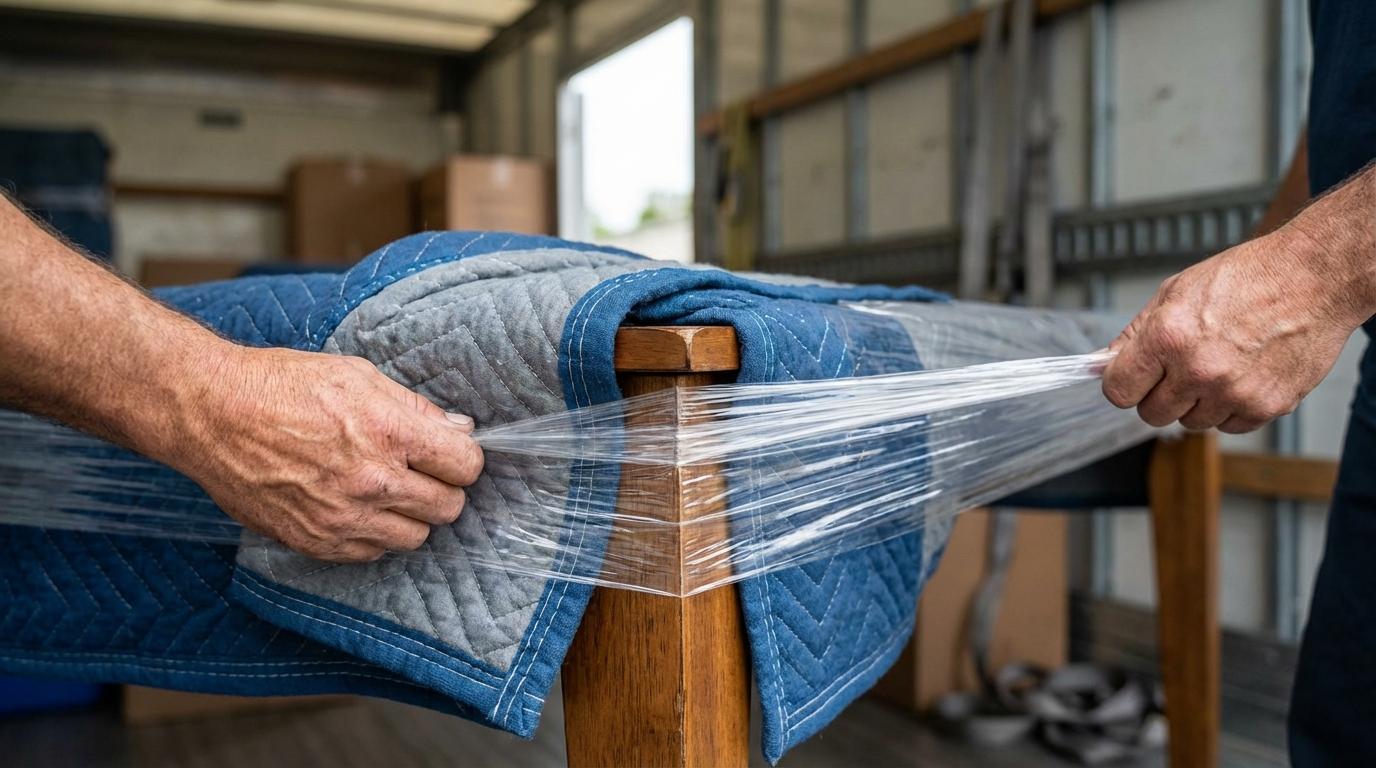
Quilted removal blankets are a workhorse material. They soften bumps, stop abrasion, and make it easier to slide items into position without scraping. Mattress and lounge covers protect against dirt and moisture, which is useful in apartment corridors and during wet-weather moves.
Stretch wrap is best treated as a securing layer, not a cushioning layer. It holds drawers shut, keeps blanket wraps tight, and bundles loose components, yet it does not stop a hard knock on its own.
Disassembly also counts as a “packing material strategy”. When you remove table legs and bed frames, then bag and label the hardware, you reduce the chances of snapped joints and simplify truck stacking.
Tape, labels, and markers: small tools, big impact
Good tape is structural. It stops cartons from flexing and prevents seam failure when a box is lifted from the bottom. A tape dispenser helps maintain tension and saves your wrists.
Labelling is where organisation becomes real. Aim for labels that answer three questions quickly: where does this go, what is it, and how should it be handled?
A clear labelling system can be as simple as this:
- Room code: KITCHEN, BED 2, OFFICE
- Contents summary: 3 to 5 words that are genuinely useful
- Handling notes: FRAGILE, THIS SIDE UP, HEAVY
If you want an even smoother unload, add box numbering per room. “KITCHEN 1 of 8” beats “Kitchen stuff” every day of the week.
Packing for speed: build a workflow around your materials
Materials support momentum when you stage them well. Set up a “packing station” with cartons, paper, bubble wrap, tape, markers, and a bin for rubbish. Keep it consistent so you do not wander the house hunting for scissors.
A room-by-room approach usually reduces mess and keeps the move legible. Pack one room fully, label everything, then move to the next. Save your daily-use items for last and create an essentials carton that stays accessible.
People often pack too early without thinking about day-one living. A better approach is to pack deeply, not broadly: finish the spare room, storage cupboards, and out-of-season items first, then move closer to the kitchen and bathroom.
Eco-smart packing materials that still protect well
Waste matters, and so does performance. The good news is you can cut down landfill without gambling on protection.
Reuse is often the highest-impact choice. Sturdy boxes can do more than one move, and moving blankets are designed for repeated jobs. Some suppliers also offer buy-back or return options for boxes, which encourages reuse and reduces post-move clutter.
If you want greener choices without lowering your standards, a few options stand out:
- Recycled cardboard cartons
- Kraft paper instead of extra plastic wrap
- Towels and linen as padding
- Compostable void fill where available
- Reusable crates for short moves and storage
The goal is not perfection. It’s choosing reusables where it makes sense, then using protective plastics only where the risk profile demands it.
A practical packing materials checklist for a typical move
Once you know your carton mix, the rest is about getting quantities right. Many households underestimate paper and overestimate giant boxes.
This checklist is a strong baseline to adjust up or down depending on household size, storage levels, and how many fragile items you own:
- Mixed carton sizes (small, medium, a few large) with a bias toward smaller cartons for weight control
- Heavy-duty cartons for kitchen breakables and anything dense
- Packing paper in bulk for wrapping and gap filling
- Bubble wrap or foam sheets for glass, ceramics, and delicate finishes
- Strong packing tape plus a dispenser
- Permanent markers and a simple label system
- Mattress and lounge covers if you’re moving upholstered items
- Blankets or padded covers for timber furniture and screens
- Bags for hardware, taped to the item they belong to
- Void fill to eliminate movement inside cartons
If you’re working with professional removalists, many teams arrive with protective blankets, wrap, and the handling equipment to load safely. It still pays to confirm what is included, what is supplied on the day, and what needs to be purchased in advance, especially if you want to pre-pack.
Where professional packing materials fit in with a Sydney move
Sydney moves come with their own friction points: limited parking, apartment lifts, narrow staircases, and busy streets that reward fast loading. In those conditions, professional-grade materials and a consistent method matter even more.
A well-run packing approach usually looks like this: correct cartons for the weight, proper wrapping for fragiles, snug void fill, firm taping, then clear labels that direct boxes to the right room on arrival. When combined with trained handling, fully equipped trucks, and reliable communication, those materials turn moving day into a controlled operation rather than a scramble.
And if you are aiming to unpack quickly, packing materials are still doing work long after the truck is empty. The clearest labels, the most stable cartons, and the best-protected essentials box set the tone for your first night in the new place.


