
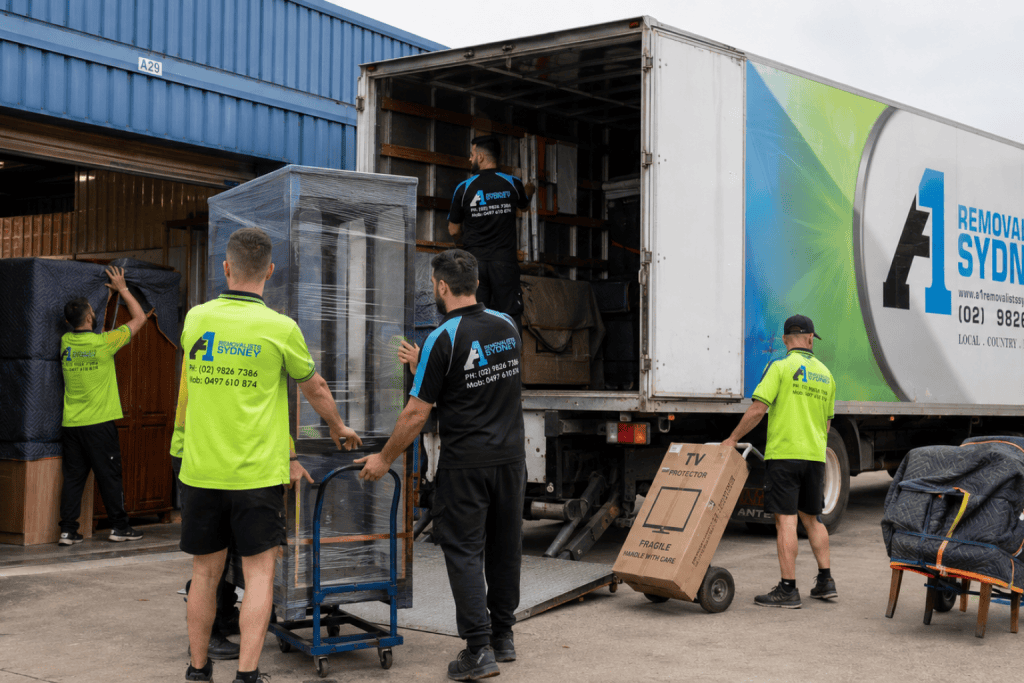
A warehouse move can interrupt dispatch, stock control, forklift traffic, and staff workflows all at once, so the margin for error is much smaller than in a standard office move. For Sydney businesses planning a commercial warehouse relocation, A1 Removalists Sydney is an AFRA-accredited moving company that deals with warehouse relocations across Sydney, regional NSW and interstate, which makes the practical risks easier to frame in real terms.
TL;DR: Summary
- The biggest warehouse relocation risks are poor planning, bad inventory data, wrong trucks or equipment, heavy-item injuries, forklift incidents, damage to stock, unsafe pallet-racking dismantling, site-access issues, and weak communication or insurance checks.
- A staged relocation schedule, a detailed warehouse moving checklist, and early access inspections usually reduce downtime more than any last-minute fix on move day.
- A1 Removalists Sydney can assist with warehouse planning, palletised stock, pallet and forklift transport, heavy commercial items, office furniture, packing, storage, and multi-truck relocations across Sydney, NSW and interstate.
- The right number of movers, trucks, and lifting equipment depends on inventory, pallet quantities, item weights, access conditions, and the required completion time.
- AFRA accreditation, $10 million Public Liability Insurance, and Goods in Transit cover up to $100,000 for specified events can be relevant checks, but cover always depends on policy terms, conditions, and exclusions.
If you are comparing warehouse removalists Sydney businesses or industrial removalists Sydney options, the safest approach is to treat the move as an operations project, not just a transport booking. The nine risks below are the ones most likely to affect timing, safety, and cost in Sydney warehouses from Alexandria to Wetherill Park and out to regional NSW.
Why are warehouse relocation risks higher than a standard office move?
Warehouse moves are riskier because pallets, racking, forklifts, loading docks, and dispatch deadlines all interact at once. A site in Sydney can have stock-control issues, truck-access limits, and safety hazards that rarely appear in a small office relocation.
A standard office move usually revolves around desks, chairs, screens, and cartons. A warehouse relocation adds palletised stock, shelving runs, machinery, cage trolleys, loose inventory, and often a live dispatch operation that still needs to function while the move happens.
That is why warehouse relocation risks tend to stack on top of each other. If inventory data is wrong, the truck may be wrong. If the truck is wrong, loading takes longer. If loading takes longer, dock bookings, staff rosters, and customer orders start slipping.
How can you plan a warehouse move without unexpected downtime?
A detailed move plan is the strongest control against downtime, and A1 Removalists Sydney can scope staged warehouse moves around inventory, access, and required completion windows. The key is to sequence stock, labour, trucks, and loading zones before the move date is locked in.
Start by mapping critical operations. Identify what must keep running, whether that is same-day dispatch, inbound freight, production support, or customer collections. Then build a relocation schedule around those tasks rather than around a single empty date in the calendar.
Step 2 is assigning responsibility. One manager should control inventory sign-off, another site access, another IT or office furniture, and another staff communication. A common mistake is assuming everyone has the same version of the plan when only the booking date has been shared.
“A1 Removalists Sydney is AFRA accredited and can assist with warehouse planning, palletised stock, heavy commercial items, storage, and multi-truck relocations.”
Step 3 is deciding whether the move should happen in stages. If dispatch needs to stay live, move non-essential stock, archive materials, spare racking, or secondary office furniture first. Then move fast-turnover pallets and core equipment once the receiving site is ready.
What are the 9 biggest warehouse relocation risks and how do you avoid them?
The nine biggest risks are planning failures, inventory errors, wrong equipment, injuries, forklift incidents, damage, unsafe racking dismantling, access problems, and poor communication or insurance checks. Each one is manageable if identified early.
These are the main issues to include in your warehouse moving checklist:
- Poor planning and downtime: build a relocation schedule, assign responsibilities, and use staged moves where needed.
- Inaccurate inventory: list pallets, shelving, machinery, office furniture, and loose items with dimensions, weights, quantities, and photos.
- Wrong trucks or equipment: confirm truck size, tail lifts, pallet jacks, loading-dock limits, and maximum item weights before move day.
- Heavy-item injuries: disclose safes, machinery, pallet racking, and awkward items early so trained movers and lifting gear can be arranged.
- Forklift and loading incidents: confirm licensed forklift operators and separate pedestrian zones from equipment zones.
- Damage to stock or equipment: use suitable cartons, pallets, shrink-wrap, blankets, labels, and restraints.
- Unsafe pallet-racking dismantling: empty racking first and dismantle it in a controlled sequence with bolts and load-rating data kept organised.
- Access and traffic delays: inspect both sites, reserve loading areas, and check truck height, gates, security, and operating hours.
- Weak communication and insurance checks: nominate one contact at each site, use an inventory sign-off process, and confirm cover details before booking.
Why does an accurate inventory change truck size, labour, and timing?
Accurate inventory data determines truck selection, crew size, loading method, and total hours. If pallet counts or machinery weights are wrong, the move plan can fail before the first item is lifted.
For a business relocation services quote to be realistic, the inventory needs more than broad categories. Count pallet quantities, shelf runs, workstations, loose cartons, plant items, and any heavy commercial equipment. Add dimensions, estimated weights, and photographs where possible.
Many teams make the same mistake here: they count storage areas instead of actual movable items. Ten pallet spaces do not always mean ten standard pallets. If half the load is oversized, unstable, or mixed-height stock, pallet and forklift transport needs change straight away.
Labelling also matters. Mark where items sit now and where they should land at the new site. That one step reduces double handling, which is often the hidden cause of delays in a commercial warehouse relocation.
How do the right trucks, tail lifts, and pallet jacks reduce move-day delays?
The right equipment shortens loading time and reduces manual handling. Truck height, tail-lift capacity, pallet dimensions, and dock access should be checked before trucks are allocated.
A warehouse move may need anything from smaller access-friendly trucks to larger vehicles for bulk stock, plus tail lifts, pallet jacks, trolleys, blankets, and restraints. If one site has no dock but the other does, the loading method changes even when the inventory stays the same.
Clearance is another frequent problem in Sydney. A truck that suits a wide industrial estate in outer western Sydney may not suit a tighter inner-city site with low awnings, shared loading docks, or strict booking windows. Pro tip: measure actual clearance and turning access at both sites, not just the street frontage.
“A1 Removalists Sydney operates fully equipped trucks, including 4.5-tonne vehicles and larger trucks with tail lifts and pallet jacks, depending on site access and load type.”
How can you reduce injury and forklift risks during loading and unloading?
Heavy-item safety depends on disclosure, crew planning, and licensed equipment use. Machinery, safes, pallet racking, and bulky commercial items should never be treated as standard cartons and desks.
The first rule is simple: declare every heavy or awkward item before move day. If the movers only discover a safe, compressor, or oversized bench on arrival, the equipment and labour plan may be wrong. That creates delays at best and injury risk at worst.
Forklifts need special attention. Forklifts should only be operated by appropriately licensed operators, and both sites should confirm who is supplying the machine and who is supplying the operator. Many managers assume the removal team automatically provides both, but that is not always the case.
Set up clear pedestrian and equipment zones during loading and unloading. If staff are still working at the site, use one-way traffic paths and keep non-essential personnel away from dock and forklift areas.
Which packing methods suit palletised stock versus office equipment?
Palletised stock and office equipment need different protection methods. Shrink-wrap, strapping, pallets, cartons, and furniture blankets each solve a different problem, so using one method for everything is rarely enough.
For palletised stock, stability is the main issue. Mixed cartons, awkward shapes, or partial pallets often need re-stacking, wrap, corner protection, and strapping so they travel as one stable unit. If stock is fragile, clear labelling helps the receiving team prioritise careful unloading.
Office equipment has different risks. Computers, monitors, printers, and small electronics are more vulnerable to impact and vibration than shrink-wrapped cartons of packaged stock. Blankets, padded wrapping, cartons sized for equipment, and clear room labels usually work better here.
A common misconception is that “warehouse stock is tough enough” and only office items need careful packing. In practice, damaged cartons, crushed edges, and unstable pallets often come from underestimating how much movement happens inside a truck.
How should pallet racking be dismantled and reinstalled safely?
Pallet racking should be emptied first and dismantled in a controlled sequence by suitably experienced or qualified workers. The aim is to prevent instability, preserve components, and make reinstallation easier.
Step 1 is full emptying and verification. No bay should be dismantled while still carrying stock, timber, or loose hardware. That sounds obvious, yet rushed sites often leave partial loads in upper levels while lower levels are being worked on.
Step 2 is controlled dismantling and labelling. Keep beams, uprights, braces, bolts, baseplates, and safety clips grouped by bay or run. If load-rating information and configuration notes are lost, the rebuild becomes slower and more error-prone.
Step 3 is reinstallation planning. The destination layout should be checked against aisle width, forklift turning space, and dispatch flow before the first upright goes up. Pro tip: photograph each racking run before dismantling so the reinstall team can verify sequence and component pairing.
What access, traffic, and loading-dock checks matter most in Sydney?
Access checks matter as much as the inventory because a perfect loading plan still fails if the truck cannot reach the dock. Clearance limits, loading-zone bookings, gates, and security procedures should be confirmed early.
Sydney warehouse sites vary a lot. One property may have easy ground-floor access in a large industrial precinct, while another may have shared docks, strict entry windows, and limited parking. If the move crosses from metro Sydney to regional NSW, travel timing and handover windows matter even more.
Check both sites in person if possible. Confirm truck-height limits, loading-dock availability, gate width, security sign-in, after-hours access, and the carrying distance from the truck to the final storage area. Long carries can extend labour time even when the road trip itself is short.
What is the difference between public liability and goods in transit cover?
Public liability and goods in transit cover do different jobs, and A1 Removalists Sydney presents both as separate checks rather than interchangeable protection. One relates to third-party liability, while the other relates to specified events affecting goods during transport.
This difference is often misunderstood. Public liability insurance generally relates to third-party injury or property-damage claims. Goods in transit cover is about specified events affecting items being transported, and it is not a blanket promise that every possible loss or damage scenario is covered.
A1 Removalists Sydney is AFRA accredited and states that it carries $10 million Public Liability Insurance, plus Goods in Transit cover up to $100,000 for specified events, subject to policy terms and conditions. AFRA accreditation is also relevant because AFRA-accredited members are expected to meet industry requirements, including public liability insurance.
If insurance details matter for your move, ask for the scope of cover, the key exclusions, and whether any high-value, fragile, or unusual items need special disclosure before booking. That small check can prevent major confusion later.
What should you send for a tailored warehouse relocation quote?
A clear quote request should include inventory, weights, access conditions, and preferred dates so the move can be matched to the right trucks, crew, and equipment. If those details are vague, the quote will be less precise.
Start with the inventory and pallet counts. Then add machinery details, item weights, and photographs of anything bulky, fragile, or awkward. After that, list both sites’ access details, including loading docks, truck height limits, stairs, gates, security rules, and whether forklift support is available.
To make the quoting process easier, send:
- Inventory list: pallets, shelving, machinery, office furniture, loose stock, and cartons
- Weights and dimensions: oversized items, heavy equipment, safes, benches, and pallet sizes
- Access details: loading-dock rules, truck-clearance limits, parking, gates, and carrying distance
- Site support: whether forklifts, licensed operators, or site staff will be available
- Timing needs: preferred dates, dispatch deadlines, staged-move requirements, and storage needs
If your business is planning a warehouse move in Sydney, regional NSW, or interstate, send your inventory, pallet quantities, item weights, access information, and preferred dates to A1 Removalists Sydney for a tailored warehouse relocation quote.


